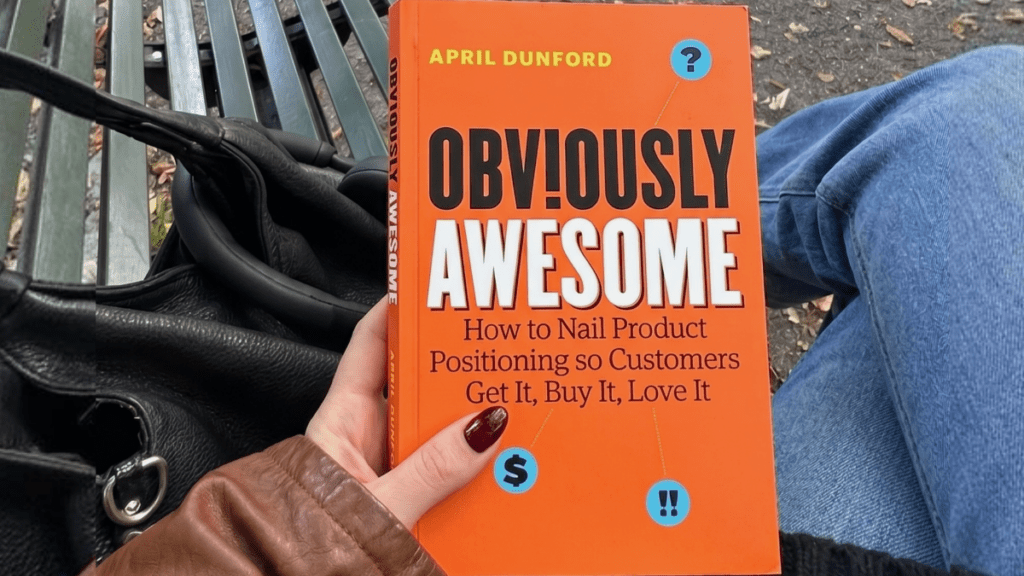
Let’s talk about… Obviously Awesome, by April Dunford
There’s an experiment that stuck with me. The Washington Post took one of the best violinists in the world, someone who fills concert halls at $300 a seat, and had him play in a subway station during rush hour. Same violinist. Same skill. Same music. Over an hour, a thousand people walked past. Almost nobody stopped. He made a couple of dollars.
The product didn’t change. The context did.
That story opens Obviously Awesome, a book by April Dunford, and it’s the perfect place to start this new “Let’s talk about…” post. Dunford has spent over 20 years helping companies reposition their products, from giants like IBM to early-stage startups still trying to find their place in the market. Along the way, she noticed something that kept repeating: good products that didn’t sell, not because they were bad, but because nobody understood why they should matter.
If you’ve ever left a sales call feeling like you had to explain your value four different ways, and the person on the other side still walked away saying “oh, so you’re kind of like…?” — this book is for you.
The problem isn’t always marketing
Here’s the idea that hit me the hardest. When something doesn’t sell, the automatic reaction is to add more noise: more ads, more content, more posting, more budget. It’s like turning up the volume on a message that’s being said in the wrong language.
Dunford’s point is simple. In a lot of cases, the real problem isn’t volume. It’s positioning. People don’t understand what you’re selling, or why they should pick you over the thousands of other options one click away. And that’s not something more advertising can fix. It’s a context problem.
Positioning, in her words, isn’t a tagline or a polished sentence on your website. It’s the frame that gives your potential customer everything they need to understand, in minutes, what your product is, why it’s different, and whether it deserves their attention. That frame can be built on purpose. Or it can happen by accident, which is what happens to most businesses.
Signs you have a positioning problem (and don’t know it)
One of the most frustrating things the book points out is that almost nobody names positioning as the real issue. People assume it’s a sales problem, a pricing problem, a “we need more ads” problem. But the signs are usually pretty clear:
- Your current clients love you, but new prospects never quite get what you do.
- Your sales cycles drag on because you keep explaining the same thing over and over.
- People compare you to things that have nothing to do with what you actually offer.
- You’re constantly pushed to lower your price, because in the client’s mind, you’re competing in the wrong category.
If any of this sounds familiar, you’re not alone. And the good news is, according to Dunford, this can be fixed without rebuilding your product from scratch.
The two traps almost everyone falls into
The book names two mistakes that show up in businesses of every size and industry.
The first trap is staying attached to the idea you originally wanted to build, without noticing your product changed along the way. Dunford explains it with a simple image: if you set out to bake a cake, you’ve already made a bunch of decisions about who you’re selling to, who you’re competing with, and what you can charge. But if that cake turns into something bite-sized, wrapped differently, meant for a different moment — you’re still playing by rules that no longer apply. The product evolved. The story didn’t.
The second trap is designing for a market that already moved on. You can spend years offering the same thing, the same way, while the world around you shifts: new competitors show up speaking a different language for the same problem, client expectations change, something that used to be irrelevant becomes essential. Your product didn’t necessarily get worse. The landscape changed, and your message stayed frozen.
Both traps have the same fix: position on purpose instead of letting it happen by default.
The five pieces (plus one) of positioning
One of the most useful parts of the book is breaking positioning down into concrete pieces that connect to each other. The order matters, and Dunford is clear about starting with the first one.
1. Competitive alternatives. This isn’t your “official” competition. It’s what your best customer would do if you didn’t exist. Often the answer isn’t another company like yours — it’s a spreadsheet, an intern, a freelancer, or just living with the problem. Getting this right changes who you’re actually competing against in your client’s mind.
2. Unique attributes. These are the things you have that those alternatives don’t. They only count if you define them against the alternatives above, not against some abstract category.
3. Value and proof of value. A technical feature means nothing until it turns into a real benefit for the client, and that benefit needs proof: data, testimonials, measurable results. Your own opinion about your value doesn’t count as evidence.
4. Target market characteristics. Not everyone values the same thing the same way. Figuring out what your best clients have in common — the ones who buy fast, never ask for a discount, and recommend you without being asked — is the key to knowing exactly who to focus on.
5. Market category. This is the frame that sets expectations the moment you describe yourself one way or another. Pick the right category and those expectations work in your favor. Pick the wrong one and you’ll spend all your energy fighting them.
Bonus: relevant trends. Trends can make your product feel current and urgent, but only if they actually connect to what you do. If the trend doesn’t fit, it just creates confusion instead of interest.
These five pieces work like a chain. Move one, and the others shift too. That’s why Dunford recommends always starting with competitive alternatives and building the rest from there.
Three ways to position yourself
The book lays out three styles of positioning, each with its own logic and its own risk.
Head to head. You compete directly in a category the market already understands. The upside: you don’t have to explain anything from scratch. The downside: if there’s a clear leader, you’re always playing away from home. This only makes sense if you’re that leader, or if the category exists but doesn’t have one yet.
Big fish, small pond. You take a slice of an existing market and become the clear reference point there. You still benefit from the fact that people already understand the general category, but you focus on a specific need the leader isn’t serving well. According to the book, this is the smartest path for most businesses starting out or working with limited resources — word of mouth inside a focused niche moves much faster than in a massive, general market.
Create a new game. This is the boldest option, and also the most expensive in time and money, because you have to teach the market what your category even is, why it matters, and why you’re the one leading it — all at the same time. When it works, the reward is huge, because you’re the one setting the rules. But there’s a real risk: you can do all the educational work and still lose the leadership spot to a bigger competitor who swoops in later.
The process, in practice
Dunford lays out a ten-step process that’s been tested with hundreds of companies, but the core of it comes down to a handful of concrete actions:
- Start with the clients who love you most, not your whole customer base. That’s where the pattern lives.
- Ask them, in their own words, what they’d do if you didn’t exist, and how they’d describe you to a friend who’s never heard of you. Write it down exactly as they say it, no interpreting.
- Define your real competitive alternatives first, before anything else.
- Isolate the attributes that only you have, compared to those alternatives, and make sure you can prove them.
- Connect every attribute to the actual value it creates for the client, not how technical it sounds.
- Choose your market category carefully, since it’s the thing that sets (or ruins) your client’s expectations.
- Revisit your positioning every six months, or whenever something important shifts in your competitive landscape. This isn’t a one-time exercise.
Why this book felt so useful to me
What I loved most about Obviously Awesome is that it doesn’t ask you to reinvent your product or throw away what you’ve built. It asks for something a little more uncomfortable: let go of the story you tell yourself about what you do, and look at it with fresh eyes, like someone meeting you for the first time.
Working in B2B marketing, this connects directly to something I see all the time: the same experience can be told in completely different ways depending on who you’re talking to, without stretching a single fact. It’s not spin. It’s finding the right frame so what’s already valuable actually looks that way.
If you feel like your product, your service, or even your personal brand are better than the market gives them credit for, chances are you don’t need a bigger budget or more content. You need to sit down, ask the right questions, and choose the context you show up in on purpose.
My challenge for you this week: list your five best clients (or, if you’re building a personal brand, the five people who valued your work the most). Look for the pattern. Then ask one of them, exactly this: “What would you have done if I didn’t exist?”
Their answer will probably tell you more about your positioning than any brainstorm ever could.
✨ From a girl who didn’t find the way and decided to build one.