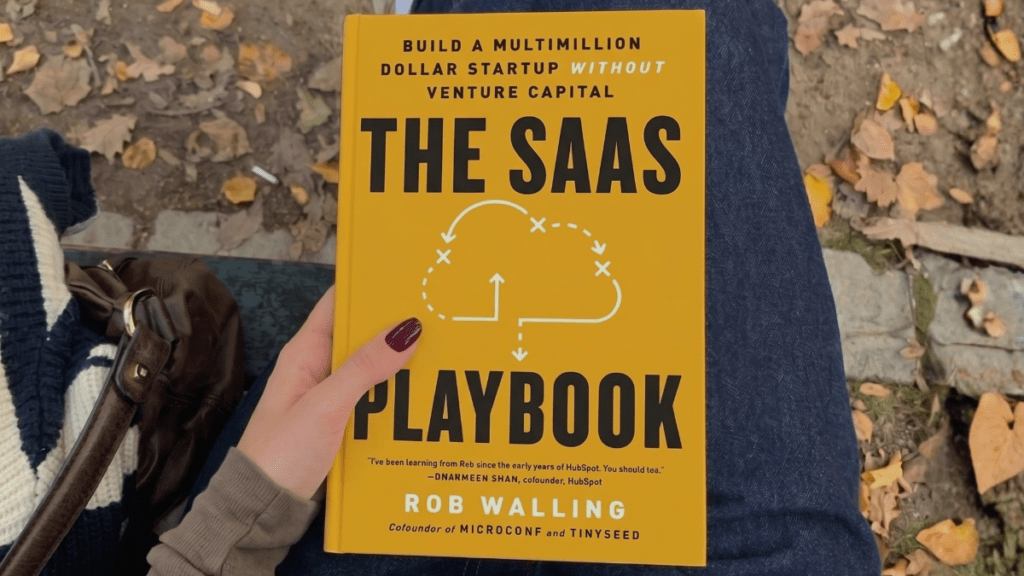
The SaaS Playbook Review: 7 Lessons on Building a SaaS Marketing Strategy From Outside the Industry
You don’t need to work in SaaS to start understanding SaaS.
That’s the line I keep coming back to after spending a week inside Rob Walling’s The SaaS Playbook — 170 pages read specifically through a market, pricing, and sales lens, because I’m a growth marketer training to work inside B2B SaaS and MarTech companies.
I spent years doing B2B marketing without knowing that a SaaS business runs on completely different logic. You’re not selling a product once. You’re selling a relationship that has to survive month after month, renewal after renewal. Nobody explains this to you until you’re inside a SaaS company. Or until you open the right book.
And that’s really the point of this article. The real problem for most marketers trying to break into SaaS isn’t lack of access to a SaaS job. It’s not knowing that this knowledge is documented, learnable from the outside, and something you can start applying today — without waiting for anyone’s permission to call yourself a SaaS marketer.
Below are seven lessons from the book that reshaped how I think about a SaaS marketing strategy, broken into the areas that matter most: product-market fit, pricing, channel selection, sales, and the metrics that actually predict growth.
- The SaaS Playbook Review: 7 Lessons on Building a SaaS Marketing Strategy From Outside the Industry
- What The SaaS Playbook Is Actually About
- Lesson 1: Product-Market Fit Is a Process, Not a Milestone
- Lesson 2: Pricing Is the Biggest Lever in a SaaS Marketing Strategy
- Lesson 3: Choosing the Right SaaS Marketing Approaches for Your Funnel
- Lesson 4: Sales Demos Are Education, Not a Pitch
- Lesson 5: The Metrics That Actually Predict SaaS Growth
- Lesson 6: Not All Competitive Moats Are Created Equal
- What This Means If You’re Breaking Into SaaS or MarTech From Outside
- Key Takeaways
- FAQ
What The SaaS Playbook Is Actually About
Rob Walling has spent close to two decades inside the bootstrapped SaaS world. He’s the cofounder of MicroConf and TinySeed, and he’s built and sold several SaaS companies, including the email marketing automation platform Drip. The SaaS Playbook condenses that experience into a founder’s field guide covering market strategy, pricing, marketing, team structure, and the metrics that separate a healthy SaaS business from one that’s quietly plateauing.
What makes the book useful for marketers — not just founders — is that pricing, positioning, and channel selection aren’t treated as separate departments. They’re treated as one connected growth system. That’s exactly the mindset a growth marketer needs to develop before stepping into a SaaS or MarTech role.
Lesson 1: Product-Market Fit Is a Process, Not a Milestone
There’s a persistent myth in the marketing and startup world: build a great product and it sells itself. Even genuinely brilliant products get compared to Apple, as if flawless design alone explains their success.
The reality is that even Apple spends hour-long “commercials” disguised as product launches. If a trillion-dollar company still markets aggressively, every SaaS company should assume it needs to as well.
The real problem isn’t the product. It’s that most founders — and most marketers — treat product-market fit as something you achieve once and move past, instead of something you keep refining through ongoing customer conversations. Walling is direct about this: talking to prospects, current customers, and churned customers is one of the highest-leverage uses of a founder’s or marketer’s time, because it directly informs pricing, positioning, and marketing copy.
For anyone coming into SaaS marketing from a different vertical, this is reassuring. Deep customer research is a skill you can bring with you. It transfers.
Lesson 2: Pricing Is the Biggest Lever in a SaaS Marketing Strategy
If there’s one section every aspiring SaaS marketer should read twice, it’s the pricing chapter. Pricing isn’t a finance decision that marketing works around — it’s arguably the single biggest lever in the entire business model.
Segment Before You Price
The starting point isn’t picking a number. It’s segmenting your customers by usage and the value they get from the product. Walling uses SquadCast, a podcast recording tool, as an example: a hobbyist podcaster and a large network like NPR use the exact same software, but they get wildly different value from it — and should be priced accordingly. Getting this segmentation right is what makes tiered pricing feel fair instead of arbitrary.
Expansion Revenue Beats Chasing New Logos
One of the clearest “cheat codes” in the book is expansion revenue: designing pricing around a value metric that grows alongside your customer’s own success (seats, usage volume, subscriber counts) so that upgrading to a higher tier feels like a natural side effect of the customer’s own growth, not a hard sell. This is a subtle but important shift for marketers used to thinking primarily about acquisition — retention and expansion are just as much a marketing responsibility as top-of-funnel growth.
Underpricing Is a Growth Ceiling, Not Humility
Perhaps the most quotable idea in the whole book: if nobody’s complaining about your price, it’s probably too low. Underpricing isn’t a modest, customer-friendly move — it’s a structural growth ceiling. Charging $10 instead of $100 a month means you need ten times as many customers to hit the same revenue, and it also cuts off entire marketing channels you simply can’t afford to use at that price point.
This reframes pricing as a marketing decision, not just a revenue one. Your ARPA (average revenue per account) directly determines which channels — paid acquisition, outbound sales, content, PR — are even financially viable for your funnel.
Enterprise Customers Are Priced Differently, On Purpose
Founders coming from a technical or non-sales background tend to underprice enterprise deals badly, comparing them to consumer software instead of the true cost of custom integrations, procurement processes, and dedicated support. A useful rule of thumb from the book: enterprise tiers should run 10 to 20 times your standard plan, not two or three times — otherwise you can’t fund the account management and sales effort enterprise customers require.
Lesson 3: Choosing the Right SaaS Marketing Approaches for Your Funnel
This is where the book gets genuinely tactical, and it’s the section most directly useful for a growth marketer’s day-to-day work.
Match Your Funnel Type to Your Price Point
High-touch funnels — demos, sales calls, human-led onboarding — only make economic sense above roughly $500 a month in contract value. Below that threshold, the cost of a sales-assisted process eats your margin alive, and a self-serve or low-touch funnel is the only sustainable option. This single principle explains why so many SaaS marketing strategies fail: they try to run a high-touch playbook on a low-touch price point, or vice versa.
The Dual Funnel “Cheat Code”
One of the more advanced ideas is the dual funnel: running a wide, low-touch funnel that brings in volume and word-of-mouth at a low price point, alongside a premium high-touch funnel targeting enterprise accounts. The low-touch side builds brand recognition and social proof that eventually feeds and legitimizes the high-touch side. Companies that get this right end up with two engines growing the business simultaneously instead of one.
There Are More Marketing Channels Than You Think — Prioritize With ICE
The book lists roughly twenty distinct B2B SaaS marketing approaches, from SEO and PPC to integration marketing, cold outreach, affiliate programs, and community building. The mistake most marketers make isn’t picking the wrong channel — it’s trying to run too many at once.
Walling recommends the ICE framework to prioritize: score each potential channel on Impact, Confidence, and Ease of implementation, then focus resources on your top one or two. In practice, that usually means running one fast-moving channel (like cold outreach) alongside one slow-building channel (like SEO or content) at the same time, rather than spreading effort across ten tactics that never get enough attention to actually work.
Lesson 4: Sales Demos Are Education, Not a Pitch
Even for marketers who don’t own the sales function directly, this section reframes how demos and sales conversations should be positioned in your funnel. The most useful mental model in the book: think of yourself as an unpaid expert helping the prospect solve a problem with software, not someone trying to force a fit between your product and their needs.
Practically, that means qualifying prospects before a demo, asking about the problem they’re trying to solve rather than walking through every feature, and being willing to tell a poor-fit prospect that your product isn’t right for them. It’s a philosophy that should also shape how marketing writes landing pages, demo request forms, and lead qualification criteria — attracting the right prospects matters more than attracting the most prospects.
Lesson 5: The Metrics That Actually Predict SaaS Growth
This is the section that felt most like unlocking a new vocabulary. Every SaaS marketer needs fluency in these numbers, even if finance owns the dashboard.
The 3 High / 3 Low Framework
Beyond the obvious headline numbers — MRR and month-over-month growth — Walling recommends tracking six metrics, three you want low and three you want high:
Push down:
- CAC (Cost to Acquire a Customer): all marketing and sales costs divided by new customers acquired in a period.
- Sales effort: the length of your sales cycle and number of touchpoints required to close.
- Churn: the percentage of recurring revenue lost each month. For most bootstrapped B2B SaaS companies, gross churn under 3% is considered healthy, and anything above 8–10% is a serious warning sign.
Push up:
- ACV (Annual Contract Value): what a customer pays over a year — a more actionable metric for most SaaS businesses than lifetime value, because it reflects near-term cash flow rather than a multi-year projection.
- Expansion revenue: revenue growth from existing customers upgrading, independent of new customer acquisition.
- Referrals: new customers who arrived because an existing customer recommended you — typically your highest-converting, lowest-effort acquisition channel.
Net Negative Churn Is the Real Cheat Code
When expansion revenue from existing customers outpaces the revenue lost to churn, a business reaches net negative churn — meaning it can grow revenue in a given month without adding a single new customer. It’s a rare and powerful state, but it requires both healthy expansion revenue and genuinely low gross churn (generally in the 0–3% range) to achieve.
Vanity Metrics Are a Trap
A recurring warning throughout the book: page views, free sign-ups, and email list size mean very little without conversion context. The real question is always how many of those visitors or free users become paying, retained customers. For a growth marketer, this is a useful discipline to bring into every reporting conversation — impressive top-of-funnel numbers should always be paired with what happens further down the funnel.
Lesson 6: Not All Competitive Moats Are Created Equal
Founders — and marketers — tend to believe that unique features are what protect a business from competitors. The book pushes back on this directly: features are a temporary advantage at best, because competitors can and will copy them within months.
The moats that actually compound over time are integrations (the more a customer’s workflow depends on your product, the harder it is to leave), brand and positioning, owned organic traffic channels, and high switching costs. Recognizing which of these your product can realistically build is a strategic marketing question, not just a product one — and it should shape long-term content, partnership, and positioning decisions rather than a constant race to ship new features.
What This Means If You’re Breaking Into SaaS or MarTech From Outside
Before reading this book, I already knew how to do growth marketing. What I didn’t have was the vocabulary a SaaS company actually speaks internally: ARPA, ACV, expansion revenue, net negative churn, ICE scoring. Knowing the concept of “customer retention” is different from knowing that a specific segment’s churn rate can flip from -4% to +11% depending entirely on pricing tier — and that this single insight can change an entire growth strategy.
That translation — from general B2B marketing experience into SaaS-specific language and frameworks — is exactly the gap a lot of experienced marketers face when trying to move into SaaS or MarTech without having worked inside one. The good news, and the whole premise of this article, is that the gap is learnable from the outside. It’s documented. You don’t need permission to start closing it today.
Key Takeaways
- Product-market fit is an ongoing practice built on customer conversations, not a one-time milestone.
- Pricing is a marketing decision as much as a financial one — it determines which channels you can even afford to use.
- Match your funnel type (high-touch vs. low-touch) to your price point, and consider a dual funnel as you scale.
- Use the ICE framework to prioritize channels instead of running too many at once.
- Track the 3 High / 3 Low metrics — CAC, sales effort and churn down; ACV, expansion revenue and referrals up.
- Real competitive moats come from integrations, brand, owned traffic, and switching costs — not features alone.
- The knowledge gap between “outside SaaS” and “inside SaaS” is smaller and more learnable than it looks.
FAQ
What is the biggest pricing mistake SaaS founders make, according to The SaaS Playbook? Underpricing. Rob Walling argues that if no one is complaining about your price, it’s probably too low, since low pricing forces you to acquire far more customers and limits which marketing channels you can afford to use.
What’s the difference between ACV and LTV in a SaaS marketing strategy? ACV (Annual Contract Value) reflects what a customer pays over 12 months, while LTV (Lifetime Value) projects total revenue over the full customer relationship. The book recommends focusing on ACV because it better reflects near-term cash flow, which matters most for bootstrapped companies.
What are the 3 High / 3 Low metrics in SaaS? The three metrics to push down are CAC (cost to acquire a customer), sales effort, and churn. The three to push up are ACV, expansion revenue, and referrals. Together they indicate both business health and when growth is likely to plateau.
This review is part of my “Let’s talk about…” series, where I break down marketing and business books through a growth marketer’s lens. Follow along for the next one.